




We’re looking at a world that’s feeling a bit shaky right now, between the headlines of conflict and the quiet hum of our home offices. We’re talking about a massive collision between global energy security and the way we actually get our work done in 2026.
First off, we’ve got to address the elephant in the room The Shadow Over the Socket; The Hormuz Factor—or rather, the tanker in the strait. The escalating friction between Iran and the US-Israel alliance isn’t just a “somewhere else” problem. It is a “your electricity bill and your gas tank” problem. The Strait of Hormuz is the world’s most sensitive carotid artery for energy. About a fifth of the world’s total oil consumption passes through that narrow stretch of water.
Let’s put your University on top!

When tensions spike there, the global energy market doesn’t just flinch; it goes into a full-blown panic. We aren’t just talking about higher prices at the pump anymore. In 2026, energy security is national security. If that strait is choked, the ripple effect hits the power grids that fuel our routers, our laptops, and the data centers keeping our AI tools running.
Now, let’s look at the Asia-Pacific region. This part of the world is the engine room of the global economy, but it’s an engine room that’s incredibly thirsty for imported energy. We’ve seen what happens when the lights go out or the fuel runs dry.
Take Vietnam, for example. In recent times, they’ve faced brutal heatwaves coupled with power shortages that forced factories to shift their operating hours to the middle of the night just to keep the grid from collapsing. Or look at Pakistan and Sri Lanka, where energy imports became so expensive due to global volatility that “load shedding”—planned blackouts—became a daily reality for millions.
But here’s the interesting part: these countries aren’t just sitting in the dark. They are pivoting, and they’re pivoting fast.
- Vietnam is aggressively deregulating its renewable energy sector, allowing “Direct Power Purchase Agreements” so businesses can buy green energy directly from solar and wind farms.
- The Philippines has lifted ownership restrictions on renewable energy projects to attract massive foreign investment in offshore wind.
The common thread here? A desperate, necessary rush toward decentralization. And that brings us to the way we work.
Is “Work From Anywhere” (WFA) the Energy Escape Hatch?
If the grid is unstable and fuel is expensive, does commuting to a glass tower in a central business district even make sense anymore? Probably not.
Large office buildings are energy vampires. They require massive HVAC systems to keep thousands of people cool or warm, and they require those people to burn fuel to get there. By shifting to a “Work From Anywhere” model, we effectively decentralize the energy load. While homes still need power, the aggregate energy waste of a massive, half-empty corporate headquarters is significantly higher than a distributed workforce.
Buy eBook here
Moreover, WFA allows people to move. If a specific region is facing a power crisis or extreme heat, a “Digital Nomad” or a remote-capable employee can migrate to areas with more stable infrastructure or cooler climates, reducing the strain on the failing grid.
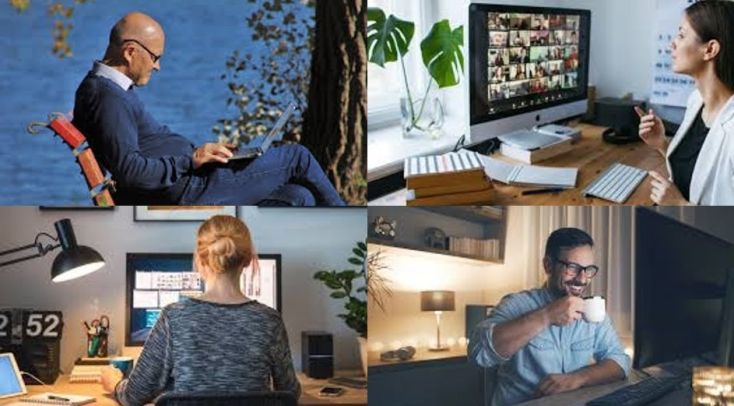
If we are going to use Remote Work as a tool for resilience, we can’t just “wing it.” We need to be professional, efficient, and—most importantly—intentional. Here is how you optimize that lifestyle in this high-stakes environment.
- The “Off-Grid” Readiness Plan
In a world of energy shortages, your first priority is Redundancy.
- Power Banks and Solar: If you’re working from home in an area prone to load shedding, a high-capacity power station (like a Jackery or EcoFlow) is no longer a luxury—it’s a business expense. Pair it with a portable solar panel.
- Dual-SIM Connectivity: Never rely on a single ISP. Have a backup 5G hotspot from a different provider. In 2026, if your internet is down, you aren’t just “away”—you’re professionally invisible.
- Energy Management (Biological, Not Just Electrical)
We mentioned this earlier, but it’s worth repeating: Manage your energy, not your time.
- Chronotype Mapping: Stop fighting your natural rhythm. If you’re a “Lion” (morning person), do your deep, analytical work at 6:00 AM. If you’re an “Owl,” save your creative bursts for 9:00 PM. Don’t force a 9-to-5 schedule on a brain that functions on a 6-to-2 or a 12-to-8 cycle.
- The “Deep Work” Fortress: Digital distractions are the “energy leaks” of the mind. Use “Focus Modes” on your devices to kill notifications during your peak hours.
- Hyper-Communication: The “Async” Revolution
In a distributed world, “over-communication” is the only way to avoid “mis-communication.”
- The 5-Minute Rule: If an email thread goes back and forth more than three times, stop typing. Record a 2-minute video message (using tools like Loom) or a voice note. It conveys tone and clarity that text lacks.
- Radical Transparency: Use shared digital dashboards (like Notion or Trello) so your boss and team can see your progress without having to ask for a “status update” meeting. Meetings are often the biggest waste of human energy in the corporate world.
- The Psychological Commute
The biggest risk of WFA isn’t that you won’t work enough—it’s that you’ll never stop working.
- The “Third Space”: Find a local cafe, a library, or even a different room in your house that is only for work. When you leave that space, the laptop stays there.
- The Shutdown Ritual: At the end of your day, literally say out loud, “The workday is over.” Close every tab. Clear your desk. This creates a “mental firewall” between your professional stress and your personal peace.
The Bottom Line: Resilience is the New Productivity
We are living through a “Great Realignment.” The conflict in the Middle East and the resulting energy jitters are forcing us to reconsider our dependence on centralized systems.
Help your University level up !

Asia-Pacific nations are leading the charge by diversifying their energy sources out of sheer necessity. As individuals, we must do the same with our careers and habits. Work From Anywhere isn’t just a perk anymore—it’s a strategic response to an unpredictable world.
By optimizing our remote setups, embracing asynchronous communication, and being mindful of our energy consumption (both electrical and mental), we don’t just survive the “energy crunch”—we thrive in spite of it.
The future of work isn’t about being in a specific seat at a specific time. It’s about being effective, regardless of where the power is coming from or what the headlines say. Stay focused, stay powered up, and keep moving forward.
visit also
Bambang Purnomo , SS-BA, CSCA, CAVM Solution Consultant