




As we move into 2026, the friendly skies are feeling decidedly less friendly. For the modern traveler, the romance of aviation has been replaced by a mathematical struggle which is on how to fit a human frame into a space designed for a briefcase. In the first few weeks of this year, a surge of viral content, regulatory tension, and corporate defensiveness has brought the issue of “seat shrink” to a boiling point.
From WestJet’s 71-cm “squeeze” to the tactical upselling maneuvers of global carriers, the industry is facing a reckoning. Is that seat sizes pitch the new “hard floor” of human endurance, or is it merely another step in the commodification of basic physical space?
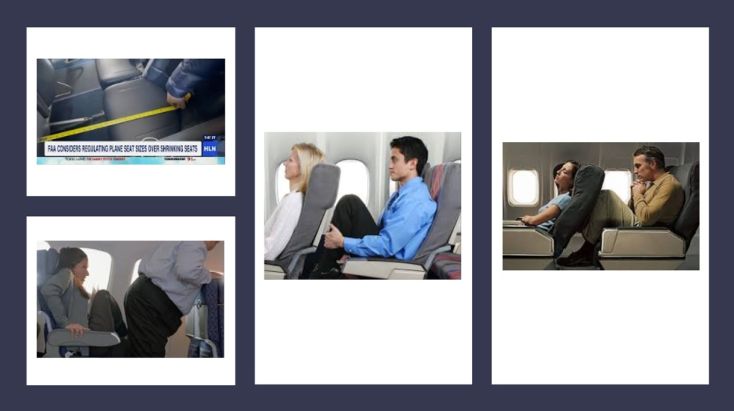
It sparks in the Video on WestJet Incident lately, The spark that reignited this global firestorm was a TikTok video captured aboard a newly reconfigured WestJet Boeing 737. In the footage, which has garnered millions of views since its posting in early January, a passenger in Edmonton demonstrated the reality of a 71-cm seat pitch. Their knees were not just touching the seat in front; they were wedged firmly into the plastic casing, making it impossible to even deploy the tray table.
As reported by CityNews Vancouver, the backlash was instantaneous. Passengers labeled the configuration “inhumane” and “claustrophobic.” However, the story took a stranger turn when Travelweek revealed that WestJet executives had actually field-tested these seats themselves on a flight weeks before the rollout. The fact that the leadership team gave the “green light” despite the visible physical constraints suggests a widening gap between corporate bottom lines and passenger reality.
A decade ago, a 79-cm seat pitch (the distance from one point on a seat to the same point on the seat in front) was the standard for economy class. Today, as budget carriers and major airlines alike look to maximize revenue per flight, that number is plummeting.
Give love to your university by filling up this short survey

As View from the Wing has tracked, carriers like Frontier and Spirit have paved the way for the 71-cm standard. What was once a hallmark of “Ultra-Low-Cost Carriers” (ULCCs) is now bleeding into “full-service” airlines. By using “slimline” seats—which feature thinner padding and smaller seatback pockets—airlines claim they are “preserving” knee room while moving seats closer together.
But travelers aren’t buying the marketing. The “slimline” revolution has been criticized for turning aircraft seats into what some call “park benches.” The lack of padding doesn’t just hurt the knees; it turns a three-hour flight into an endurance test for the lower back and neck.
Why are airlines doing this, knowing it results in a PR nightmare? The answer lies in the architecture of modern airline pricing. As analyzed maybe the degradation of “Standard Economy” is a deliberate tactical move to drive customers toward “Premium Economy.” ( source aviation business news )
By making the base product—the economy seat—sufficiently uncomfortable, airlines create a powerful incentive for passengers to pay an extra for “Economy Plus” or “Extra Legroom” sections. These sections often feature the 78 or 79 cms of space that used to be the standard. In essence, passengers are now being asked to pay a premium to reclaim the basic comfort that was taken away from them. This “upsell by discomfort” strategy has made Premium Economy the most profitable square footage on the aircraft, far exceeding the margins of First Class or standard Economy.
The Safety Elephant in the Room
While the public focuses on comfort, advocacy groups are sounding the alarm on safety. The FlyersRights organization has been a tireless critic of shrinking seats, arguing that this isn’t just a matter of sore knees—it’s a matter of life and death.
Did your university shape you? Return the favor! Your positive review is our top grade

In the event of an emergency, the FAA mandates that a full aircraft must be evacuated in 90 seconds. However, critics argue that the testing for these evacuations often uses athletic, able-bodied participants in controlled environments. As seats get closer together, the “bracing position” becomes physically impossible for taller or larger passengers. Furthermore, the “clogging” of aisles during an emergency is exacerbated when passengers are wedged so tightly into their rows that they cannot quickly pivot into the aisle.
Despite these concerns, the FAA has historically been hesitant to mandate a minimum seat size. As Forbes notes, the agency has previously ruled that current seat sizes do not yet impede safety to a degree that requires federal intervention. This stance has left passengers at the mercy of the market, where “low fares” are used to justify increasingly cramped conditions.
The “Recline Wars” and the Breakdown of Social Etiquette
The physical shrinking of the cabin has led to a psychological shrinking of passenger patience. The “Recline Wars” have become a staple of viral travel news in 2026. When a seat has only 71 cms of pitch, a 8-cm recline from the person in front isn’t just a minor annoyance—it’s an invasion of the little space the rear passenger has left.
This has led to the rise of “Knee Defenders”—illegal gadgets used to lock the seat in front—and frequent “air rage” incidents. Airlines have responded in two ways: some, like Frontier, have moved to “pre-reclined” seats that don’t move at all, while others have simply left passengers to fight it out amongst themselves. This lack of clear policy, combined with the physical stress of the environment, has turned the modern aircraft cabin into a powder keg of social friction.
By offering 82-87 cms of pitch in economy and focusing on the “experience” of travel, these carriers are winning the hearts (and wallets) of long-haul travelers. This creates a stark divide in the 2026 aviation landscape: a “budget-first” West where space is a luxury, and an “experience-first” East that is rapidly dominating global transit.
1 Great Review. Help your University to succeed

In short, as 2026 progresses, the “Great Squeeze” shows no signs of letting up. Airlines are betting that passengers will always choose the lowest price, even if it means 71 cms of misery. However, the viral nature of the WestJet backlash and the growing political pressure on the FAA suggests that there is a limit to what the traveling public will endure. Until regulations change, the burden of the “squeeze” remains on the passenger. Whether through paying for upgrades, choosing carriers with better reputations, or simply “bracing” for the worst, the modern traveler is a participant in a grand experiment in human density.
Bambang Purnomo , SS-BA, CSCA, CAVM Solution Consultant